World
Imran Khan Set for Release in 2026, Declares PTI MNA Aslam Ghuman
PTI MNA Aslam Ghuman claims Imran Khan will walk free in 2026 as legal appeals dismantle remaining state prosecution cases.
10. September 2026

How Ansar Allah transformed from a northern Yemeni insurgency into a regional force reshaping defense cooperation across Saudi Arabia, Pakistan, and Turkey.
The Houthi movement, officially known as Ansar Allah, is an armed Zaidi Shia political and military organisation originating from Yemen's northern Saada province. Since seizing the capital Sana'a in 2014, the group has evolved from a mountain guerrilla force into a dominant regional combatant whose long-range ballistic missiles, combat drones, and Red Sea blockades directly challenge Saudi Arabian national security and Western maritime trade.
Recent military flare-ups along the Yemeni border in September 2026 have thrust the decade-long war back to the forefront of international diplomacy. What began as a localized rebellion against state neglect and foreign influence now dictates the strategic posture of neighboring Gulf monarchies, pulling regional powers like Pakistan and Turkey into complex security frameworks designed to safeguard critical infrastructure and sea lanes.
Understanding the conflict requires tracing the roots of Zaidism, a distinct branch of Shia Islam that ruled Yemen for over a thousand years until the 1962 republican revolution. In the 1990s, religious scholar Hussein Badreddin al-Houthi established the "Believing Youth" movement in Saada province to counter the perceived marginalization of Zaidi traditions and the growing influence of Saudi-funded Wahhabism along Yemen's northern border.
Friction between Hussein al-Houthi's followers and the regime of President Ali Abdullah Saleh exploded into open military conflict in 2004. Between 2004 and 2010, the Yemeni central government waged six brutal military campaigns—known as the Saada Wars—against the rebels. Hussein al-Houthi was killed by government forces in late 2004, transforming him into a martyr and cementing his family's leadership over the movement that adopted his name.
The 2011 Arab Spring uprisings fractured Yemen's political structure, forcing President Saleh from power and installing his deputy, Abdrabbuh Mansur Hadi. Exploiting the political chaos, rampant corruption, and fuel subsidy cuts, Houthi fighters marched south from Saada in September 2014. In a stunning display of tactical maneuvering, they seized government headquarters in Sana'a, allied briefly with their former enemy Saleh, and eventually placed President Hadi under house arrest before he fled to Riyadh in early 2015.
In March 2015, Saudi Arabia launched Operation Decisive Storm at the head of a coalition of ten nations, aiming to defeat the Houthis and restore Hadi's internationally recognized government. Saudi military strategists initially anticipated a rapid air campaign that would push the rebels back to their northern strongholds. Instead, the war entrenched into a grinding proxy conflict that reshaped military doctrine across the Arabian Peninsula.
Leveraging Iranian technical assistance, local arms stockpiles, and captured state hardware, Ansar Allah systematically built an asymmetric arsenal. The group modified Soviet-era Scud missiles and deployed domestically modified drones, such as the Samad and Qasef series, to strike deep inside Saudi territory. High-profile attacks targeted oil refineries in Abqaiq and Khurais in September 2019, temporarily knocking out half of Saudi Arabia's crude oil production, while frequent strikes hit civilian airports in Abha, Jizan, and Najran.
Control over the strategic Bab al-Mandeb strait enabled the Houthis to leverage maritime routes carrying roughly 12 percent of global seaborne trade. By targeting international vessels and naval assets, Ansar Allah demonstrated its ability to impose severe economic costs far beyond the Arabian Peninsula, forcing global shipping lines to reroute around Africa's Cape of Good Hope.
The persistent Houthi missile and drone threat forced Saudi security planners to overhaul their national defense posture. Rather than relying exclusively on traditional Western suppliers, Riyadh expanded bilateral and trilateral security cooperation with major Muslim-majority military powers, specifically Pakistan and Turkey.
Pakistan's military relationship with Saudi Arabia dates back to the 1982 bilateral security convention, under which thousands of Pakistani troops have remained stationed inside the Kingdom for training and advisory roles. When Riyadh sought direct Pakistani troop commitments inside Yemen in 2015, Islamabad's parliament famously voted to maintain official neutrality. However, behind-the-scenes defense collaboration deepened significantly. Pakistan provided specialized counter-insurgency expertise, joint border defense training, and military intelligence sharing to bolster Saudi territory against cross-border raids.
Simultaneously, Turkey entered the regional security calculus by offering advanced military technology, including uncrewed aerial vehicles, anti-drone defense systems, and naval architecture. The emerging strategic convergence between Saudi capital, Turkish defense-industrial technology, and Pakistani operational expertise forms a tri-lateral pillar intended to deter non-state actors and stabilize volatile regional borders without triggering broader international escalation.
As peace talks mediated by Oman and China fluctuate between diplomatic breakthroughs and renewed localized skirmishes, the fundamental realities on the ground remain unaltered. Ansar Allah exercises de facto control over major population centers housing nearly 70 percent of Yemen's population. Their transition from a mountain faction to a heavily armed regional power has permanently altered the geopolitics of the Middle East, compelling neighboring powers to forge new military doctrines to protect energy security and strategic waterways.
The Houthis, officially known as Ansar Allah, belong to the Zaidi branch of Shia Islam originating from northern Yemen's Saada region. They emerged in the 1990s as a revivalist movement resisting state marginalization and foreign political influence.
Saudi Arabia sought to secure its borders and vital infrastructure against Houthi drone and missile strikes by bolstering defense collaboration with Pakistan and Turkey. This trilateral alignment combines Pakistani military training and operational expertise with Turkish defense hardware and technology.
Ansar Allah controls territory bordering the Bab al-Mandeb strait, a crucial bottleneck where roughly 12 percent of global seaborne trade passes through the Red Sea. Their maritime strikes have disrupted global supply chains and forced commercial ships to take longer routes around Africa.
GuruAlpha News Desk
The GuruAlpha News team delivers accurate, timely coverage of breaking news, markets, technology, and lifestyle — in English and Urdu.
PTI MNA Aslam Ghuman claims Imran Khan will walk free in 2026 as legal appeals dismantle remaining state prosecution cases.
10. September 2026
Alexander Zverev swept Botic van de Zandschulp in straight sets to set up a US Open semifinal clash with Karen Khachanov.
10. September 2026
Saudi Arabia's business confidence index climbed to 56.7 points in September 2026, propelled by surging manufacturing orders and expanding services.
10. September 2026
Electoral gains by nationalist parties across Europe threaten to paralyze EU sanctions against Moscow and dismantle military aid packages for Kyiv.
10. September 2026
Hiroshima survivor Isao Harimoto, whose 3,085 career hits remain Nippon Professional Baseball's unbroken gold standard, has died at age 86.
10. September 2026
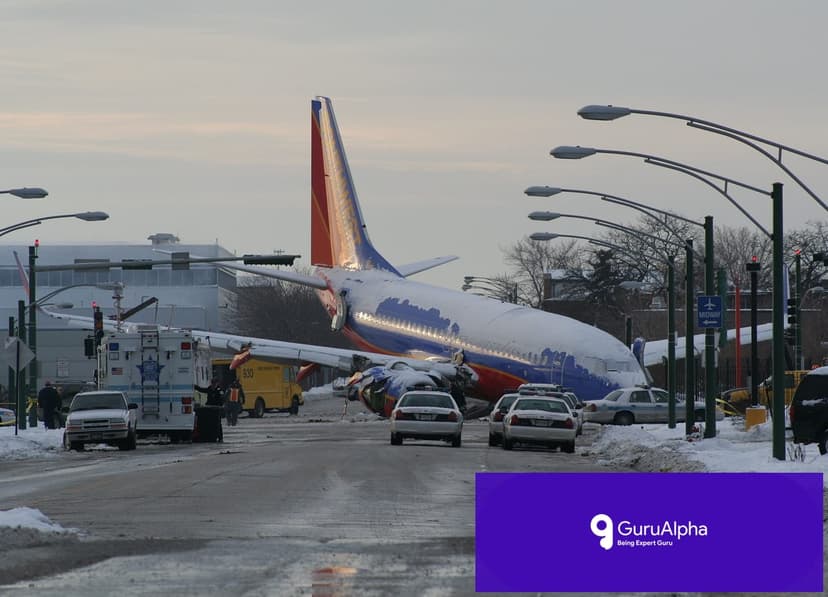
Cockpit recordings reveal a pilot issued repeated speed warnings for nearly two minutes before an Amazon cargo plane overshot a Miami runway.
10. September 2026
Primark abandons its store-only model, rolling out home deliveries four years after testing click-and-collect across major markets.
10. September 2026
Apple brings back the obsidian black finish to its flagship iPhone Pro lineup, satisfying loyal purists who prefer subtle, professional hardware design.
10. September 2026
OpenAI has added Paul Christiano, a pioneer of human feedback alignment, to its governing board as existential risk debates intensify across Silicon Valley.
10. September 2026
Volvo brings back the discontinued XC40 plug-in hybrid with Google Gemini AI integration and refreshed design as global electric vehicle momentum shifts.
10. September 2026